Looking for UV Resistant Decking in Colorado? Here’s What Front Range Sun Actually Does to Your Deck
You made a significant investment on that deck. You picked out the boards, had it built, And have enjoyed so many memorable moments in that space. But then slowly, season by season, it started looking a little less like a deck and a lot more like a problem.
The color washed out. The boards feel rough underfoot. Maybe a few are starting to crack along the grain. You’re thinking about pressure washing it again, or maybe restaining it yet again.
Here’s the thing most homeowners in the Denver metro don’t realize: your deck isn’t aging the way decks do in most of the country. It’s aging faster. Significantly faster. And the reason has everything to do with where you live.
TL;DR
At 5,000+ feet and 300+ sunny days a year, your deck absorbs up to 30% more UV than sea level. Material choice isn’t optional here — it’s everything.
What UV Radiation Actually Does to a Deck
Let's start with the science, because it matters for the decisions you're about to make.
UV radiation — the same invisible rays that cause sunburn — is one of the most destructive forces acting on any outdoor surface. When UV light hits the surface of your deck, it doesn't just warm it up. It triggers a chemical process called photodegradation, which breaks down the molecular structure of the material itself.
For wood decking — especially pressure-treated lumber, which is by far the most common choice in residential construction — this process is particularly damaging. Wood gets much of its color and structural rigidity from a compound called lignin. Lignin is essentially the glue that holds wood fibers together and gives the grain its natural warmth and richness. UV radiation aggressively attacks lignin, breaking it down through a chain reaction of free radical oxidation.
The results show up in three distinct ways:
Color loss. That rich, warm brown tone pressure-treated lumber starts with fades to a flat silver-gray. This isn't just a cosmetic issue — it's a visible sign that the lignin holding your deck together is actively degrading. Once the color goes, the integrity of the surface is already compromised.
Surface texture damage. As UV breaks down the wood's natural oils and surface fibers, the boards dry out and become brittle. The smooth surface you walked on barefoot in year one becomes rough, splintery, and unpleasant by year three or four. Cracking along the grain follows shortly after.
Loss of structural integrity. UV degradation doesn't stay on the surface. Over time, it penetrates deeper layers of the wood, weakening the board's ability to handle mechanical stress — things like the weight of furniture, foot traffic, or even just expanding and contracting with temperature changes. A deck that looks serviceable from a distance can be genuinely fragile underfoot.
And here's the maintenance math that rarely gets discussed honestly: if you're using pressure-treated wood, protecting it from UV requires resealing or restaining every one to two years. Miss a season, and the degradation that's already occurring accelerates. You're not maintaining a deck at that point — you're playing catch-up with the sun.
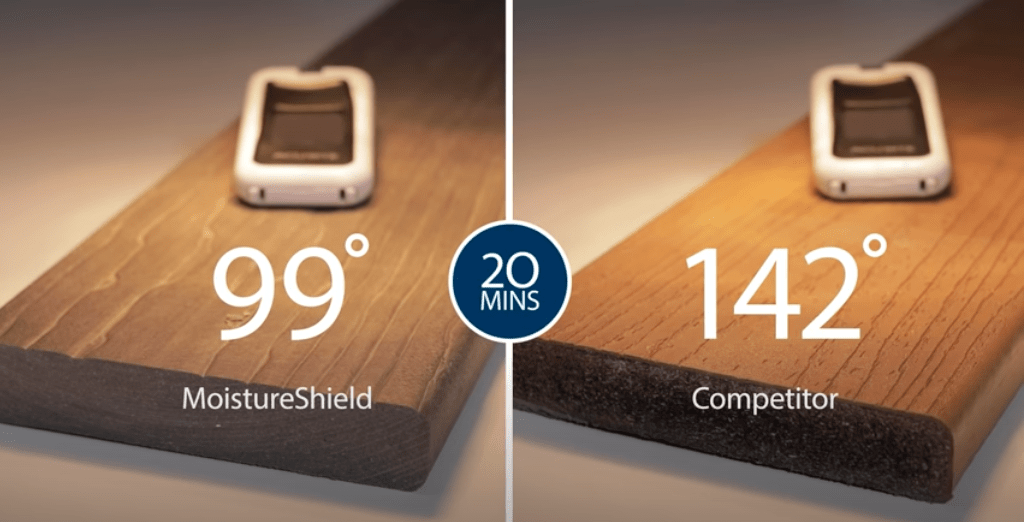
Mile High UV intensity
Denver sits at 5,280 feet above sea level — the famous Mile High elevation that locals know by heart but rarely think about in the context of their outdoor structures. The communities surrounding Denver tell a similar story. Littleton sits around 5,360 feet. Highlands Ranch is closer to 5,800 feet. Golden approaches 5,700 feet. Boulder is around 5,430 feet.
That elevation is not just a fun fact for trivia night. It has a direct and measurable effect on UV intensity.
The atmosphere acts as a natural filter for UV radiation. At sea level, you have the full weight of the atmosphere above you absorbing and scattering UV rays before they reach the ground. As you go higher, that atmospheric buffer thins out. Less atmosphere means more UV gets through — and it arrives more intense, with less of its energy dissipated.
The numbers are striking. UV intensity increases by roughly 4% to 5% for every 1,000 feet of elevation gain. That means a homeowner in Highlands Ranch is absorbing approximately 25% more UV exposure than someone living at sea level in the same latitude. For Golden or Littleton, you're still looking at a 20% or greater increase. Even at Denver's famous 5,280 feet, the math puts local UV exposure roughly 16% higher than coastal cities at the same latitude.
Now combine that elevation effect with Colorado's famous sunshine. The Front Range averages more than 300 sunny days per year — more than Miami, more than Los Angeles. That's not just pleasant weather for outdoor entertaining. It's 300-plus days of elevated UV battering your deck without meaningful breaks.
The result is a decking environment that is genuinely more punishing than nearly anywhere else in the continental United States. A deck in Atlanta, Houston, or even Phoenix benefits from lower elevation and more cloud cover interrupting the UV cycle. A deck in Littleton or Highlands Ranch gets more intense UV radiation, more consistently, day after day, for a longer portion of the year.
That's why decks on the Front Range tend to look noticeably worse faster than comparable decks in other parts of the country. It's not that the workmanship was lower or the maintenance was neglected. It's that the environment is fundamentally harder on outdoor materials — and most homeowners aren't choosing materials with that reality in mind.